Today is the day
23/07/26 09:06
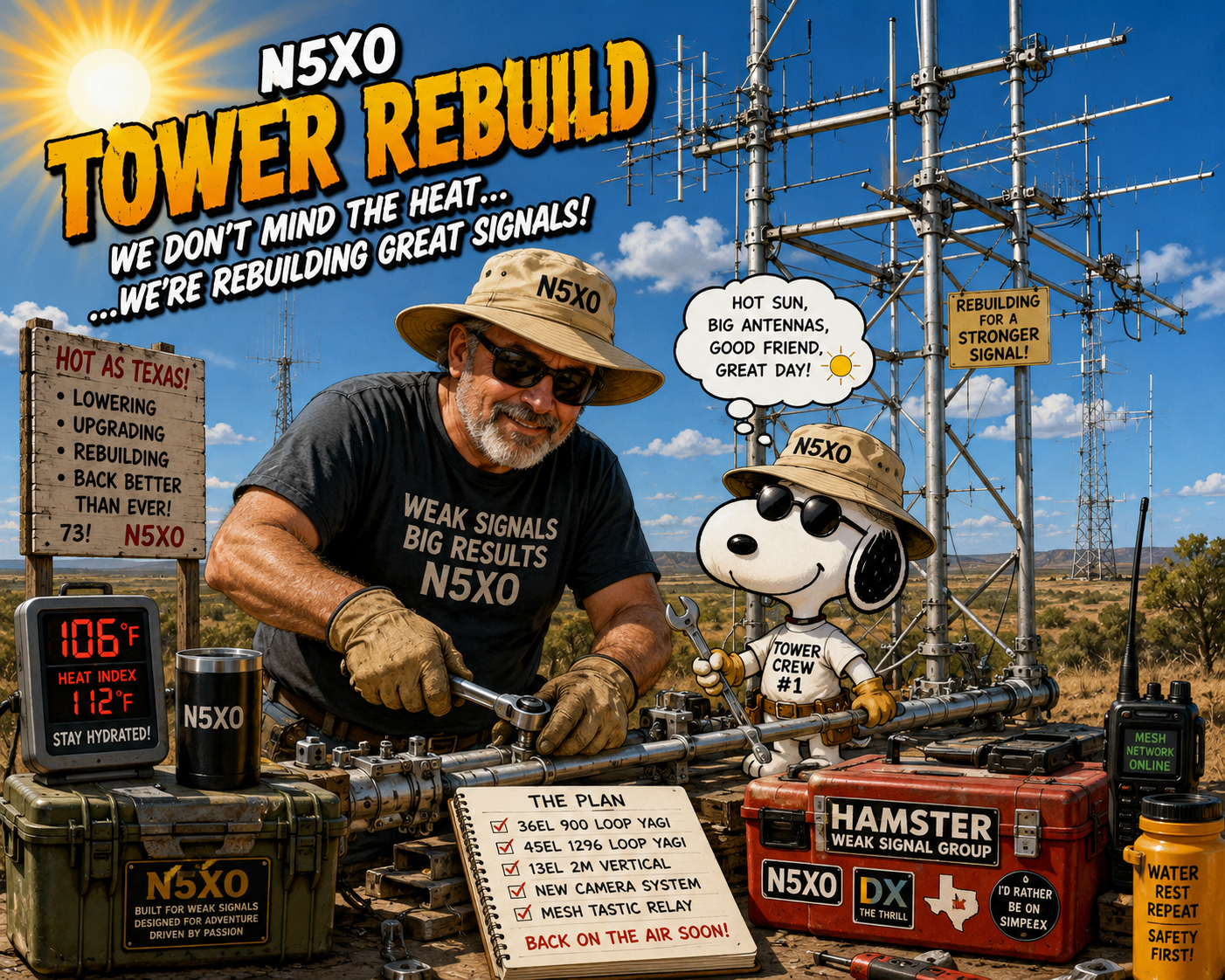
After months of planning, ordering equipment, repairing storm damage, and waiting for the right opportunity, the next major phase of the N5XO Weak Signal Station officially begins.
This morning we'll be lowering one of the largest H-frame antenna assemblies on the property to begin a complete rebuild and upgrade. It's a project that has been in the planning stages since lightning struck the station, and by the time we're finished, this tower will be significantly more capable than it has ever been.
What We're Lowering
The H-frame currently supports an impressive collection of antennas and equipment, including:
- Two stacked 2-meter Quad antennas
- One 1.25-meter Quad
- Two stacked 36-element 1296 MHz Yagis
- A solar-powered Meshtastic relay
- A G7 2-meter FM simplex antenna
- Two stacked K5VH omnidirectional antennas used for weak-signal SSB work
Recovering From the Lightning Strike
Mother Nature had other ideas earlier this year.
A lightning strike took out several important pieces of equipment, including:
- The 180-degree 8-megapixel panoramic camera
- The solar-powered Meshtastic relay
- Damage to other station equipment that has already been repaired or replaced
The Upgrades
When this project is complete, the tower will return to service with a number of exciting additions.
900 MHz Weak Signal Expansion
One of the most exciting additions is a 36-element 900 MHz Loop Yagi, giving us greatly improved performance on one of my favorite weak-signal bands.
Bigger Performance on 1296 MHz
The pair of stacked 36-element 1296 MHz Yagis will be replaced with a single high-performance 45-element Loop Yagi.
Sometimes bigger isn't simply more antennas—it's better engineering. This new antenna promises outstanding gain while simplifying the overall installation.
New Camera System
The destroyed panoramic camera will be replaced with a much more capable surveillance system.
The new installation will include:
- Dual-head camera system
- Infrared night vision
- 4-megapixel imaging
- Continuous monitoring of the other towers
- Weather observation
- Horizon monitoring
- Additional station security
Meshtastic Returns
The Meshtastic solar relay is also being completely rebuilt and returned to service.
The relay has become an important part of our growing regional mesh network, and I'm looking forward to getting it back on the air.
More FM Simplex Range
One addition I've wanted for quite some time is a dedicated 13-element vertically polarized 2-meter beam.
The goal is simple:
Push our FM simplex coverage even farther across South and Central Texas.
As many of you know, I've become a huge believer that FM simplex is one of the most underused capabilities in amateur radio. Every improvement we make helps demonstrate just how far simplex communication can really go when stations are properly equipped.
Working Around the Texas Heat Dome
The biggest challenge may not be the antennas...
It may be the weather.
Central Texas is currently sitting beneath an intense heat dome, meaning we'll be working around dangerous afternoon temperatures. Safety comes first, so most of the heavy work will happen during the cooler morning hours, with shorter work sessions once the Texas sun begins doing what it does best.
If Mother Nature cooperates, I'm hoping to have everything rebuilt, tested, and back in the air within one to one-and-a-half weeks.
Building the Ultimate Weak Signal Station
Every improvement brings us one step closer to the vision I've had for years—a station capable of operating continuously from 160 meters all the way through 10 GHz, supporting everything from local FM simplex to long-distance weak-signal work, microwave experimentation, emergency communications, Meshtastic networking, and beyond.
This isn't just maintenance.
It's another major step toward building one of the most versatile VHF/UHF/SHF amateur radio stations I've ever imagined.
Stay Tuned
Over the coming days I'll be posting photos, videos, drone footage, progress reports, and hopefully plenty of stories from the rebuild.
By the time this project is complete, the tower will not simply be repaired—it will be stronger, smarter, and more capable than ever before.
The tower is coming down...
So it can come back up better than ever.
73,
Greg Lewis – N5XO Founder, HAMster Weak Signal Group
The Final Phase Begins – Building the Ultimate N5XO Station
13/07/26 09:53
There are moments in every Amateur Radio operator's journey that mark the end of one chapter and the beginning of another.
For me, that chapter begins this Wednesday.
After months of planning, repairing, redesigning, ordering parts, running new feedlines, and recovering from the lightning strike that did so much damage to our station, it is finally time to begin the final phase of the N5XO shack and antenna farm rebuild.
This isn't simply replacing broken equipment.
This is taking everything we've learned over the years—and building something even better.
Every Project Has a Goal
When I first became interested in Amateur Radio decades ago, my goal wasn't simply to talk on the radio.
It was to experiment.
To see just how far I could push my station.
To learn.
To build.
To improve.
That spirit has never changed.
The station has evolved from a simple VHF setup into a complete communications system capable of operating across virtually every Amateur Radio band. Every antenna, every feedline, every amplifier, every relay, and every piece of equipment has a purpose.
Now it's time to put the finishing touches on what has become one of the most exciting station projects I've ever undertaken.
The Work Begins
The first task will be assembling several brand-new antennas before they ever leave the ground.
Among them are two new Big Wheel 144 MHz omnidirectional antennas that will replace the faithful K5VH omnis that unfortunately became the latest victims of our local "tower maintenance crew"...
...otherwise known as the buzzards.
Those birds have managed to destroy more antennas over the years than some Texas windstorms.
The new Big Wheels should provide excellent omnidirectional horizontal coverage for weak-signal work while being considerably more rugged.
Next on the workbench is a 900 MHz antenna, adding another important piece to the station's expanding microwave capabilities.
Then comes one of the projects I'm most excited about...
A beautiful new 45-element Loop Yagi for 1296 MHz.
This antenna will replace my stacked pair of 36-element Loop Yagis and should provide even better performance on the 23-centimeter band. Every decibel counts when you're chasing distant stations, weak-signal contacts, contests, and eventually expanding even further into microwave operations.
The improvements never stop.
Giving Old Equipment New Life
Not every project involves something brand new.
One of my trusted 13-element vertical Yagis will be repaired and returned to service.
That antenna has proven itself over the years, and once back in the air it will once again serve as my long-range FM simplex antenna.
One thing our HAMster Simplex Nets have demonstrated is that repeaters aren't the only way to communicate over impressive distances.
A well-designed station...
A quality antenna...
Good feedline...
And a willingness to experiment...
Those things still matter.
Expanding the Mesh Network
Another exciting addition will be reinstalling the Meshtastic Relay that was lost in the lightning strike.
The replacement relay will once again occupy its home high on the main tower alongside the omnidirectional antennas, restoring local mesh coverage.
But we're not stopping there.
A second Meshtastic relay will be installed on another tower and paired with a highly directional dish antenna capable of being rotated as needed.
That opens the door to experimenting with long-distance mesh links and extending network coverage well beyond what an omnidirectional antenna alone could accomplish.
Experimentation is, after all, what Amateur Radio has always been about.
Infrastructure Matters
One thing most people never notice when looking at an antenna farm is what lies behind the scenes.
Feedlines.
Connectors.
Grounding.
Routing.
Planning.
Fortunately, one of the largest jobs has already been completed.
Every new feedline has already been run into the shack and terminated.
That means when antennas start going up, the infrastructure is already waiting for them.
Sometimes the work nobody sees is the work that makes the biggest difference.
Time to Lower the Towers
Toward the end of the week—or perhaps over the weekend if Mother Nature cooperates—the real fun begins.
The towers will come down.
Old antennas will come off.
New antennas will go up.
Systems will be tested.
Everything will be tuned.
Every connector checked.
Every feedline verified.
There is something incredibly satisfying about seeing months of planning finally become reality.
We're Bringing You Along
This isn't going to be one of those projects that disappears into the background.
I'm planning to document as much of it as possible.
There will be aerial footage from the drone.
GoPro footage from a head-mounted camera while working on the antennas.
Ground cameras capturing the assembly.
Time-lapse video where possible.
Hopefully you'll get to see the entire project unfold—from antenna assembly on the ground to the final installation high above the shack.
If you've ever wondered what goes into building a serious VHF/UHF/Microwave station, I think you'll enjoy following along.
One More Upgrade...
As if all that wasn't enough...
The HF station is getting some attention as well.
The existing dipole will be replaced with a new antenna, continuing the overall modernization of the station.
HF has always been an important part of the shack, and this upgrade helps ensure every part of the station is performing at its very best.
The Goal
When all of the work is complete...
Every antenna is mounted.
Every feedline connected.
Every radio tested.
Every system verified.
The N5XO station will have continuous operating capability with no gaps from 160 meters all the way through 10 Gigahertz.
Think about that for a moment.
Every Amateur Radio band from 160 meters through the microwave bands.
HF.
6 Meters.
2 Meters.
1.25 Meters.
70 Centimeters.
33 Centimeters.
23 Centimeters.
13 Centimeters.
3 Centimeters.
10 Gigahertz.
No missing bands.
No compromises.
Just a station designed to experiment, explore, communicate, and continue pushing the limits of what Amateur Radio can do.
The Adventure Continues
People sometimes ask why I continue adding antennas, experimenting with new bands, building new systems, or chasing contacts that many would consider impossible.
The answer is simple.
Because Amateur Radio was never intended to be a hobby where we stop learning.
It's a hobby where we continually ask, "What happens if I try this?"
It's about building.
Experimenting.
Improving.
Sharing what we learn.
Encouraging others to build bigger dreams than they thought possible.
So over the next several days, the work begins.
The cameras will be rolling.
The towers will be moving.
The antennas will be flying.
And I hope you'll come along for the ride.
73,
Greg Lewis – N5XO
"Never stop experimenting. The next great contact is always just one improvement away."
Summer 2026 — Monsters, Microwave, and Complete Antenna Madness
31/05/26 17:53
N5XO Blog
Summer 2026 — Monsters, Microwave, and Complete Antenna Madness
Retirement was supposed to mean slowing down.
Apparently, my version of “slowing down” involves climbing towers, rebuilding antenna arrays, replacing equipment vaporized by lightning, developing new Amateur Radio software at 2:00 in the morning, and consuming enough Monster Energy drinks to medically qualify as an alternate power source.
Welcome to Summer 2026 at the N5XO house in Converse, Texas.
Honestly… I’m having the time of my life.
This summer is shaping up to be one giant Amateur Radio adventure, and I’m more excited about the hobby right now than I’ve been in years.
Of course, Mother Nature apparently noticed I was having too much fun and decided to get involved.
As many of you know, we recently took a lightning strike that turned several pieces of equipment into very expensive decorative paperweights.
Among the fallen heroes:
But every ham knows the rules.
If smoke escapes the equipment… the project simply enters “Phase Two.”
And honestly?
I already had major upgrades planned anyway.
So instead of being depressed about it, I decided to lean fully into the madness and launch what can only be described as:
Operation: “Well… While We’re At It…”
The primary tower is scheduled for a full antenna makeover this summer.
Current plans include:
Because I honestly suspect that microwave and 10 GHz operation may end up being the final summit of my Amateur Radio career.
There’s just something fascinating about pushing farther and farther into the weak-signal and microwave world where everything becomes more difficult, more technical, more precise… and somehow even MORE fun.
The higher you go in frequency, the crazier the adventure becomes.
And apparently, I looked at that and thought: “Yep. Sign me up.”
Of course, tower work is never complete without wildlife interference.
Specifically the local buzzards and hawks who remain fully committed to destroying my horizontal omni antennas for 2 meter SSB.
At this point I’m convinced they hold planning meetings nearby.
Every time I think I’ve solved the problem, one of them lands on the antenna system with the grace and subtlety of a bowling ball dropped from orbit.
I’m fairly certain they wait until I finish repairs before launching the next attack.
Meanwhile, software development insanity continues at full speed.
Along with all the antenna projects, I’m continuing development on several Amateur Radio software projects focused heavily on VHF/UHF operation, propagation support, logging, and communication tools.
But the project that currently has me REALLY excited is a brand-new Meshtastic terminal application.
My goal is simple: Build something flexible, useful, informative, and actually enjoyable to use.
A lot of modern software feels like it was designed by engineers who are personally angry at humanity.
I’m trying very hard NOT to do that.
The new software focuses heavily on:
But honestly, one of the BEST parts of this summer has been working with other Amateur Radio clubs and helping promote weak-signal VHF/UHF activity through the HAMsters group.
That part has been incredibly rewarding.
I’ve really enjoyed encouraging operators from local and regional clubs to step outside the normal repeater world and discover just how exciting simplex, weak-signal, SSB, microwave, and long-distance VHF/UHF operation can actually be.
Because once people experience it…
Once they hear a distant weak signal rise out of the noise…
Once they work stations hundreds of miles away on frequencies most people think are “line of sight only”…
Something changes.
Suddenly the hobby becomes an adventure again.
And THAT is what I want people to experience.
Not just talking THROUGH infrastructure… …but actually communicating station-to-station.
Building antennas. Experimenting. Learning propagation. Chasing openings. Improving stations. Trying crazy ideas. Having fun.
That spirit is still very much alive.
You just have to discover where it’s hiding.
So yes…
Summer 2026 currently includes:
I wouldn’t change a thing.
73, Greg Lewis — N5XO
Summer 2026 — Monsters, Microwave, and Complete Antenna Madness
Retirement was supposed to mean slowing down.
Apparently, my version of “slowing down” involves climbing towers, rebuilding antenna arrays, replacing equipment vaporized by lightning, developing new Amateur Radio software at 2:00 in the morning, and consuming enough Monster Energy drinks to medically qualify as an alternate power source.
Welcome to Summer 2026 at the N5XO house in Converse, Texas.
Honestly… I’m having the time of my life.
This summer is shaping up to be one giant Amateur Radio adventure, and I’m more excited about the hobby right now than I’ve been in years.
Of course, Mother Nature apparently noticed I was having too much fun and decided to get involved.
As many of you know, we recently took a lightning strike that turned several pieces of equipment into very expensive decorative paperweights.
Among the fallen heroes:
- My tower-top camera system that let me monitor antenna alignment, weather, and generally keep an eye on the horizon like some retired suburban NORAD operator.
- The Meshtastic relay system.
- One of my Flex 6400M radios.
But every ham knows the rules.
If smoke escapes the equipment… the project simply enters “Phase Two.”
And honestly?
I already had major upgrades planned anyway.
So instead of being depressed about it, I decided to lean fully into the madness and launch what can only be described as:
Operation: “Well… While We’re At It…”
The primary tower is scheduled for a full antenna makeover this summer.
Current plans include:
- Adding a 45-element loop Yagi for 900 MHz weak-signal SSB operation.
- Replacing the stacked 32-element loop Yagis on 1296 MHz with stacked 45-element beasts.
- Replacing my disappointing 220 MHz quad with a proper high-performance Yagi.
- Continuing the slow but exciting move into larger antenna arrays, microwave operation, and eventually 10 GHz work.
Because I honestly suspect that microwave and 10 GHz operation may end up being the final summit of my Amateur Radio career.
There’s just something fascinating about pushing farther and farther into the weak-signal and microwave world where everything becomes more difficult, more technical, more precise… and somehow even MORE fun.
The higher you go in frequency, the crazier the adventure becomes.
And apparently, I looked at that and thought: “Yep. Sign me up.”
Of course, tower work is never complete without wildlife interference.
Specifically the local buzzards and hawks who remain fully committed to destroying my horizontal omni antennas for 2 meter SSB.
At this point I’m convinced they hold planning meetings nearby.
Every time I think I’ve solved the problem, one of them lands on the antenna system with the grace and subtlety of a bowling ball dropped from orbit.
I’m fairly certain they wait until I finish repairs before launching the next attack.
Meanwhile, software development insanity continues at full speed.
Along with all the antenna projects, I’m continuing development on several Amateur Radio software projects focused heavily on VHF/UHF operation, propagation support, logging, and communication tools.
But the project that currently has me REALLY excited is a brand-new Meshtastic terminal application.
My goal is simple: Build something flexible, useful, informative, and actually enjoyable to use.
A lot of modern software feels like it was designed by engineers who are personally angry at humanity.
I’m trying very hard NOT to do that.
The new software focuses heavily on:
- Better communication flow
- More usable information
- Increased flexibility
- Better situational awareness
- Real-world functionality
- And fewer moments where users scream at the monitor
But honestly, one of the BEST parts of this summer has been working with other Amateur Radio clubs and helping promote weak-signal VHF/UHF activity through the HAMsters group.
That part has been incredibly rewarding.
I’ve really enjoyed encouraging operators from local and regional clubs to step outside the normal repeater world and discover just how exciting simplex, weak-signal, SSB, microwave, and long-distance VHF/UHF operation can actually be.
Because once people experience it…
Once they hear a distant weak signal rise out of the noise…
Once they work stations hundreds of miles away on frequencies most people think are “line of sight only”…
Something changes.
Suddenly the hobby becomes an adventure again.
And THAT is what I want people to experience.
Not just talking THROUGH infrastructure… …but actually communicating station-to-station.
Building antennas. Experimenting. Learning propagation. Chasing openings. Improving stations. Trying crazy ideas. Having fun.
That spirit is still very much alive.
You just have to discover where it’s hiding.
So yes…
Summer 2026 currently includes:
- Tower work
- Antenna upgrades
- Microwave experimentation
- Meshtastic development
- Weak-signal operation
- Club activity
- Contesting
- Propagation chasing
- Fighting buzzards
- Replacing lightning damage
- Drinking alarming amounts of Monster
- And probably inventing several new curse words along the way
I wouldn’t change a thing.
73, Greg Lewis — N5XO
Why I hate FT-8
22/04/26 09:49
WHY I HATE FT8…
(…and why I’m also kind of in awe of it)
By Greg N5XO
Let me just say it right up front so nobody accuses me of dancing around the issue:
I hate FT8.
There… I said it.
Now before the pitchforks come out and someone fires up a 1.5 kW legal-limit keyboard response, let me follow that up with something equally true:
FT8 is one of the most brilliant things ever created in Amateur Radio.
And that, my friends, is the problem.
First — Credit Where It’s Due
The software behind FT8, developed by Joe Taylor (yes, a literal Nobel Prize-winning physicist… not your average weekend code hacker), is nothing short of astonishing.
FT8 can:
👉 Signals you cannot hear… FT8 casually logs for you like it’s ordering lunch.
From a technical standpoint, it’s jaw-dropping.
The Part Where I Start Grumbling Like an Old Guy
Now here’s where I probably sound like those guys back in the day saying:
“When they dropped the CW requirement, the hobby was doomed!”
…and I used to laugh at them.
Well guess what…
I’ve become that guy.
“The Band Is Wide Open!”
…and nobody’s there
I cannot tell you how many times this has happened:
Crickets.
Dead silence.
Meanwhile, you slide over to FT8…
…and it looks like Times Square on New Year’s Eve.
The Contest Problem (This One Hurts)
During VHF/UHF contests, something has shifted — and not in a subtle way.
But FT8?
Packed. Wall-to-wall signals.
It’s like everyone showed up to the party… but they’re all texting each other from different corners of the room.
What FT8 Gets Absolutely Right
Let’s be fair — because this matters.
FT8 has:
👉 FT8 is a massive win for Amateur Radio.
No argument.
What It Gets… Questionable
Here’s my issue — and it’s not technical.
It’s cultural.
FT8 contacts are:
👉 You’re not really communicating.
You’re exchanging:
No personality. No conversation. No “Hey, what antenna are you running?” No “Where are you located?” No “Man, the band is on fire tonight!”
Just:
Beep… decode… log… done.
The “Texting” Effect on Radio
This is where I get myself into trouble…
FT8 is doing to Amateur Radio what texting did to society.
We used to:
We send:
Efficient? Yes. Impressive? Absolutely. Satisfying?
…eh.
My Unpopular Opinion
I would love FT8 if it stayed in its lane:
The Reality Check (Because I Have One)
Here’s the part where I have to be honest with myself:
FT8 isn’t destroying the hobby.
It’s evolving it.
And whether I like it or not:
👉 A lot of operators love it 👉 A lot of new hams start with it 👉 A lot of stations depend on it
And that matters.
Final Thoughts from a Grumpy Weak Signal Guy
So where do I land?
This hobby isn’t just about making contacts.
It’s about:
The Challenge
Next time the band opens:
👉 Slide up to 144.200 👉 Or 50.125 👉 Or wherever your weak signal calling frequency is
And instead of clicking “Enable TX”…
Pick up the mic.
You might be surprised who answers.
— Greg N5XO
(…and why I’m also kind of in awe of it)
By Greg N5XO
Let me just say it right up front so nobody accuses me of dancing around the issue:
I hate FT8.
There… I said it.
Now before the pitchforks come out and someone fires up a 1.5 kW legal-limit keyboard response, let me follow that up with something equally true:
FT8 is one of the most brilliant things ever created in Amateur Radio.
And that, my friends, is the problem.
First — Credit Where It’s Due
The software behind FT8, developed by Joe Taylor (yes, a literal Nobel Prize-winning physicist… not your average weekend code hacker), is nothing short of astonishing.
FT8 can:
- Decode signals 20–24 dB below the noise floor
- Complete contacts in about 15 seconds per exchange
- Allow stations with modest antennas and low power to work the world
- Perform reliably under conditions where SSB just throws its hands up and goes home
👉 Signals you cannot hear… FT8 casually logs for you like it’s ordering lunch.
From a technical standpoint, it’s jaw-dropping.
The Part Where I Start Grumbling Like an Old Guy
Now here’s where I probably sound like those guys back in the day saying:
“When they dropped the CW requirement, the hobby was doomed!”
…and I used to laugh at them.
Well guess what…
I’ve become that guy.
“The Band Is Wide Open!”
…and nobody’s there
I cannot tell you how many times this has happened:
- 6 meters is wide open
- 2 meters is rolling with propagation
- Conditions are screaming “GET ON THE AIR!”
Crickets.
Dead silence.
Meanwhile, you slide over to FT8…
…and it looks like Times Square on New Year’s Eve.
The Contest Problem (This One Hurts)
During VHF/UHF contests, something has shifted — and not in a subtle way.
- SSB activity? Thin
- CW activity? Even thinner
- Actual conversation? Practically endangered
- a rover
- a die-hard weak signal operator
- or one of us stubborn holdouts
But FT8?
Packed. Wall-to-wall signals.
It’s like everyone showed up to the party… but they’re all texting each other from different corners of the room.
What FT8 Gets Absolutely Right
Let’s be fair — because this matters.
FT8 has:
- Opened the hobby to people with limited space, HOA restrictions, or modest stations
- Made DX accessible to folks who otherwise wouldn’t have a chance
- Provided a powerful tool for propagation testing
- Enabled scientific-level weak signal experimentation
👉 FT8 is a massive win for Amateur Radio.
No argument.
What It Gets… Questionable
Here’s my issue — and it’s not technical.
It’s cultural.
FT8 contacts are:
- Automated
- Structured
- Efficient
- Predictable
👉 You’re not really communicating.
You’re exchanging:
- callsigns
- grid squares
- signal reports
No personality. No conversation. No “Hey, what antenna are you running?” No “Where are you located?” No “Man, the band is on fire tonight!”
Just:
Beep… decode… log… done.
The “Texting” Effect on Radio
This is where I get myself into trouble…
FT8 is doing to Amateur Radio what texting did to society.
We used to:
- call people
- talk
- laugh
- share ideas
We send:
- 👍
- “k”
- “ok”
Efficient? Yes. Impressive? Absolutely. Satisfying?
…eh.
My Unpopular Opinion
I would love FT8 if it stayed in its lane:
- Bad band conditions? YES
- Testing antennas? YES
- Pushing weak signal limits? ABSOLUTELY
- the band is open
- conditions are good
- and people still choose automation over interaction
The Reality Check (Because I Have One)
Here’s the part where I have to be honest with myself:
FT8 isn’t destroying the hobby.
It’s evolving it.
And whether I like it or not:
👉 A lot of operators love it 👉 A lot of new hams start with it 👉 A lot of stations depend on it
And that matters.
Final Thoughts from a Grumpy Weak Signal Guy
So where do I land?
- I hate FT8 for what it’s doing to conversation
- I respect it deeply for what it can do technically
- I use it occasionally (don’t tell anyone)
- I wish more people would get back on SSB and actually talk
This hobby isn’t just about making contacts.
It’s about:
- sharing knowledge
- experimenting
- learning
- and yes… actually communicating
The Challenge
Next time the band opens:
👉 Slide up to 144.200 👉 Or 50.125 👉 Or wherever your weak signal calling frequency is
And instead of clicking “Enable TX”…
Pick up the mic.
You might be surprised who answers.
— Greg N5XO
How It All Started – Or, How I Accidentally Jammed Half of Texas
20/04/26 17:14
How It All Started – Or, How I Accidentally Jammed Half of Texas
If you’re looking for a story about how I carefully studied electronics, followed all the rules, and respectfully entered the world of Amateur Radio… you’re going to be disappointed.
My journey started in the mid-1960s with a screwdriver, a curious mind, and absolutely no adult supervision worth mentioning.
I grew up fascinated with electronics. Back then, if a TV or radio stopped working, it didn’t get recycled—it got thrown out. Which, to me, meant free parts store. I spent my days dragging home old sets and tearing them apart like a mad scientist, collecting tubes, resistors, capacitors, and anything else that looked important.
The beauty of those old tube circuits? They actually made sense. You could see what was happening. Solid state came along, and I hung in there. But when integrated circuits and surface mount showed up… well, let’s just say somewhere along the line the electrons started hiding from me.
Fast forward to late 1960s small-town Texas. In science class, we were learning about Guglielmo Marconi and spark gap transmitters. Most kids probably thought, “Well, that’s interesting.”
I thought: “I bet I can build one of those.”
Now, as luck would have it, another thing that was easy to find back then was Model T spark coils. Why? No idea. But they were everywhere—probably just waiting for two unsupervised kids to make poor life decisions.
A buddy of mine, Bryan, and I got our hands on a couple of those coils and did what any responsible young scientists would do:
We built our own spark gap transmitters.
Now depending on your perspective, this was either:
A long barbed wire ranch fence running behind my house.
Perfect? No. Effective? Oh… absolutely.
One cold, rainy Thanksgiving weekend, Bryan and I spent the entire day “communicating” between our houses. We used standard AM radios to listen to each other, and here’s the key detail:
No tuning required.
At the time, we thought: “Man, this is incredible!”
What we should have thought was: “If we don’t need tuning… what is this doing to literally every radio, TV, and electronic device within a 10-mile radius?”
But we were young. And apparently, not that bright.
Around 6:00 PM Saturday evening, there was a hard knock on the front door.
My father answered.
Standing there was a police officer… and two men in suits.
From the other room, I heard my name—loudly—and in a tone that suggested my life choices were about to be reviewed in detail.
I walked to the door, heart pounding, brain racing: “What did I do? What did I break? Who did I interfere with?”
Answer: Everyone.
The two guys in suits turned out to be ham radio operators who had tracked down a source of massive interference. The police officer was there… just in case this turned out to be something more serious than two kids accidentally recreating early 1900s radio technology across half the county.
After a brief investigation, it was determined:
Instead of shutting me down and walking away, those hams did something unexpected:
They talked to my father… and convinced him to let me live.
Then they did something even more dangerous:
They started mentoring me.
They introduced me to the world of Amateur Radio the right way—licenses, proper equipment, real operating—and I was hooked from that moment on.
Fast forward about eight years: I graduate high school and join the United States Navy as… you guessed it… a radioman. Apparently, once RF gets in your blood, there’s no getting it out.
After my Navy tour, life kicked in hard—in a good way. I married my high school sweetheart, we bought a house, started careers, raised a family… and somewhere along the way, Amateur Radio took a back seat.
At one point I decided to get back into it, only to discover my license had expired four years earlier. That was discouraging enough that I set it aside again.
Life stayed busy.
Then, about 15 years later, I finally had the time—and this time, I came back with a vengeance.
For years, I operated almost exclusively on HF, running my trusty old Heathkit HW-101, which I was convinced would outlive most modern radios. But in 2006, everything changed.
I bought my first new radio in decades… and for the first time started playing around on 2 meters and 6 meters.
And then…
Fate stepped in.
I discovered VHF/UHF Weak Signal operating—and suddenly, a whole new world opened up. Distance, propagation, antennas, takeoff angles… it was everything I loved about radio, turned up to eleven.
And that brings us to today.
From tearing apart junk TVs… to accidentally jamming half the county… to getting “caught” by the very people who would shape my future…
I didn’t just find Amateur Radio.
It found me—and never let go.
If you’re looking for a story about how I carefully studied electronics, followed all the rules, and respectfully entered the world of Amateur Radio… you’re going to be disappointed.
My journey started in the mid-1960s with a screwdriver, a curious mind, and absolutely no adult supervision worth mentioning.
I grew up fascinated with electronics. Back then, if a TV or radio stopped working, it didn’t get recycled—it got thrown out. Which, to me, meant free parts store. I spent my days dragging home old sets and tearing them apart like a mad scientist, collecting tubes, resistors, capacitors, and anything else that looked important.
The beauty of those old tube circuits? They actually made sense. You could see what was happening. Solid state came along, and I hung in there. But when integrated circuits and surface mount showed up… well, let’s just say somewhere along the line the electrons started hiding from me.
Fast forward to late 1960s small-town Texas. In science class, we were learning about Guglielmo Marconi and spark gap transmitters. Most kids probably thought, “Well, that’s interesting.”
I thought: “I bet I can build one of those.”
Now, as luck would have it, another thing that was easy to find back then was Model T spark coils. Why? No idea. But they were everywhere—probably just waiting for two unsupervised kids to make poor life decisions.
A buddy of mine, Bryan, and I got our hands on a couple of those coils and did what any responsible young scientists would do:
We built our own spark gap transmitters.
Now depending on your perspective, this was either:
- A brilliant early experiment in RF engineering
or - A clear warning sign to society
A long barbed wire ranch fence running behind my house.
Perfect? No. Effective? Oh… absolutely.
One cold, rainy Thanksgiving weekend, Bryan and I spent the entire day “communicating” between our houses. We used standard AM radios to listen to each other, and here’s the key detail:
No tuning required.
At the time, we thought: “Man, this is incredible!”
What we should have thought was: “If we don’t need tuning… what is this doing to literally every radio, TV, and electronic device within a 10-mile radius?”
But we were young. And apparently, not that bright.
Around 6:00 PM Saturday evening, there was a hard knock on the front door.
My father answered.
Standing there was a police officer… and two men in suits.
From the other room, I heard my name—loudly—and in a tone that suggested my life choices were about to be reviewed in detail.
I walked to the door, heart pounding, brain racing: “What did I do? What did I break? Who did I interfere with?”
Answer: Everyone.
The two guys in suits turned out to be ham radio operators who had tracked down a source of massive interference. The police officer was there… just in case this turned out to be something more serious than two kids accidentally recreating early 1900s radio technology across half the county.
After a brief investigation, it was determined:
- Not a Russian plot
- Not a military experiment
- Just two kids with spark coils and zero understanding of RF containment
Instead of shutting me down and walking away, those hams did something unexpected:
They talked to my father… and convinced him to let me live.
Then they did something even more dangerous:
They started mentoring me.
They introduced me to the world of Amateur Radio the right way—licenses, proper equipment, real operating—and I was hooked from that moment on.
Fast forward about eight years: I graduate high school and join the United States Navy as… you guessed it… a radioman. Apparently, once RF gets in your blood, there’s no getting it out.
After my Navy tour, life kicked in hard—in a good way. I married my high school sweetheart, we bought a house, started careers, raised a family… and somewhere along the way, Amateur Radio took a back seat.
At one point I decided to get back into it, only to discover my license had expired four years earlier. That was discouraging enough that I set it aside again.
Life stayed busy.
Then, about 15 years later, I finally had the time—and this time, I came back with a vengeance.
For years, I operated almost exclusively on HF, running my trusty old Heathkit HW-101, which I was convinced would outlive most modern radios. But in 2006, everything changed.
I bought my first new radio in decades… and for the first time started playing around on 2 meters and 6 meters.
And then…
Fate stepped in.
I discovered VHF/UHF Weak Signal operating—and suddenly, a whole new world opened up. Distance, propagation, antennas, takeoff angles… it was everything I loved about radio, turned up to eleven.
And that brings us to today.
From tearing apart junk TVs… to accidentally jamming half the county… to getting “caught” by the very people who would shape my future…
I didn’t just find Amateur Radio.
It found me—and never let go.